4 Ways to Actually Stick with Your Meditation Habit
More and more studies are coming out about the benefits of meditation and mindfulness
Meditation and mindfulness have become increasingly popular over the past two decades. These days, more than 400 studies get published every year adding up to a total of more than 4000 studies on meditation [1].
Psychologists and neuroscientists have shown that meditating regularly can improve stress, anxiety, and depression and that it can even lower blood pressure and slow aging [2], [3], [4].
A recent study conducted at the UCLA faculty of medicine showed that at the age of 50, the brains of regular meditators were an average of 7.5 years younger than those of non-meditators [5]. Plus with every additional year, they aged 1 month and 22 days less!
But what the hell is mindfulness anyways?
Mindfulness and mediation is a bit of an abstract concept. Is it just sitting and not thinking about anything? How do you actually do that without getting frustrated?
To most of us it is not even clear what meditation or mindfulness really are. Is it sitting quietly in a room and trying not to have any thoughts? Not at all! Meditation and mindfulness are all about cultivating positive states of mind like openness, acceptance, and a good heart. We first do this in the safety of our own homes so that we can more easily access them when life hits us hard.
There are thousands of apps, techniques and tactics. Which one do you choose and how do you stick with it?
There are many different types of meditation one can do and choosing the right one is not always obvious. In order to really stick with your meditation practice, you have to find the one that really does the trick for you. To make this task easier for you, our experts have compiled a list for you with their advice on how to choose among them.
How do you stick with a mediation practice
Unfortunately with meditation there is no instant or even short term result that you can see.
The best and fastest way to get into and stick with a meditation practice is to find a certified instructor near you that can keep you on track.
If you cannot find a good instructor near you try apps like Calm, Headspace or the Mindfulness app. These apps will guide you to build your meditation habit up gradually.
Studies show that only about 60% of people who start meditating stick with the habit [6]. How can you manage not to be among the 40% who quit meditation?
Here are 6 simple things that you can do to stick to a meditation/mindfulness practice and get the most benefits from it
Determine what is the best meditation practice(s) for you.
Test which kind of practice makes you feel the best
Get informed about the different styles of meditation by having a look at our Types of meditation article. For an overview of the benefits of some of those meditations, look them up in the habit directory.
Test which one you are most likely to stick with
In the habit directory, you will find some instructions on how to do the meditations. You can also find guided meditations for most styles on YouTube. Find the meditation practice that makes you feel the best. Meditation is not supposed to be hard or frustrating it is supposed to feel good.
Guided meditations are a great tool in the beginning. Until we know how to proceed, the guidance will help us to build a structured practice and bring us back more quickly when our minds wander away.
Set up a place for meditation
Chose a quiet space in your home
The great meditation masters from the East advise us to set up a place in our homes that we use only for meditation [7]. This can be your own personal meditation room, or just a small spot in your bedroom.
Transform this space into a sanctuary for self-discovery
Make it beautiful and keep it tidy. Don’t do any other activities there and chose a nice cushion or a chair that you use for meditation. This way, the mere sight of your meditation spot becomes an invitation for practice and your mind will not be as easily distracted.
Time your meditation practice wisely To really stick to our meditation in the long run, we need to make up our minds about when and how long to meditate and stick to that schedule.
Meditate in the mornings
Traditionally, it is said that early mornings are the best time for meditation. Because there is no new information yet, there are less disturbing thoughts than after a full day of work for example.
In her best selling book, The Willpower Instinct Kelly McGonigal shows that willpower gets depleted throughout the day and you are more likely to stick with a practice the earlier you do it in the day.
So if sticking to your meditation practice is a priority, try to do it first thing in the morning while your willpower muscles are still strong.
Naps are good but don’t turn your meditation into a nap. Don’t meditate when you are super tired.
If you can’t make it in the morning, try to reserve a time in the evening. But beware that meditating in the evenings can be harder because you can easily fall asleep once you let your body come to rest.
Find a good trigger for meditation If Meditation is part of a routine one habit can cue up another. For example if you meditate after exercising Finishing your work out can cue you to meditate. This is also known as habit stacking and was discussed in a book called Habit Stacking by SJ Scott. By always meditating around the same time, it becomes a routine and your body will prepare for your meditation session.
Know your limits and build up slowly Do not overdo it in the beginning. Go for quality over quantity! Make your mediations short and focused. 10 minutes everyday is better than 1 hour every other month. So start with 10 minute periods until you feel 100% confident to increase the length of your meditation session. This is really essential! Slowly increase the length of your meditation. If you are completely new to meditation, meditate daily for 10 minutes in the first two weeks. Then increase to 15 minutes, for another two weeks. This way you will associate positive feelings, and not boredom or nervousness, with your meditation cushion.
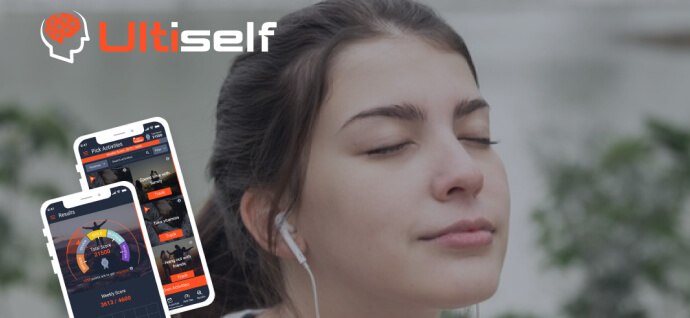
Gamify it! Just like most habits you can use basic psychology principles to make meditation really stick through gamification. Many of the most popular meditation Apps use game features like streaks and rewards to make users addicted to them. Streaks and rewards trigger dopamine releases in the brain. Dopamine is our body’s pleasure molecule and makes you body want to repeat happy experiences. Also make sure to track your meditation habit in Ultiself.
We exploit these same principles to make sure that our users stick to their habits and become their best version. Rate your day in Ultiself daily and our in-house machine-learning algorithm will identify the best bedination practice for you and the best time of the day to do it. And our advanced gamification features will make it easy for you to stick with those habits.
Don’t lose that streak and compete with your friends to see who can keep his meditation habit best!
Meditation doesn't have to be hippyish and untracked to be zen. There is nothing wrong with tracking and gamifying your meditation practice.
Downloading an App like Calm or Headspace and tracking your progress in Ultiself will make it much easier for you to stick to your new habit.
They also provide guided meditations and send practice reminders to make sure you don’t forget to practice. Make sure not to miss out on the great opportunities that modern technology offers.
Conclusion
In order to keep up your new healthy habit of meditating, there is no shame in using aids like smartphone Apps or seeking out the guidance of an experienced teacher.
But first you need to find your optimal meditation routine and the amount of time you want to practice. Refer to our types of meditation article and make sure to track your progress using Ultiself. And remember: start small and always go for quality over quantity!
Mediation is a self fulfilling prophecy. The more you meditate the more you will be in control of yourself
You will be less influenced by your usual temptations and you will be able to consciously choose which behaviors you want to turn into a new habit.
References
ExpandCollapse
Vieten, C., Wahbeh, H., Cahn, B. R., MacLean, K., Estrada, M., Mills, P., … Delorme, A. (2018). Future directions in meditation research: Recommendations for expanding the field of contemplative science. PLOS ONE, 13(11), e0205740. https://doi.org/10.1371/journal.pone.0205740
Epel, E., Daubenmier, J., Moskowitz, J. T., Folkman, S., & Blackburn, E. (2009). Can Meditation Slow Rate of Cellular Aging? Cognitive Stress, Mindfulness, and Telomeres. Annals of the New York Academy of Sciences, 1172(1), 34–53. https://doi.org/10.1111/j.1749-6632.2009.04414.x
Goyal, M., Singh, S., Sibinga, E. M. S., Gould, N. F., Rowland-Seymour, A., Sharma, R., … Haythornthwaite, J. A. (2014). Meditation Programs for Psychological Stress and Well-being: A Systematic Review and Meta-analysis. JAMA Internal Medicine, 174(3), 357–368. https://doi.org/10.1001/jamainternmed.2013.13018
Howarth, A., Smith, J. G., Perkins-Porras, L., & Ussher, M. (2019). Effects of Brief Mindfulness-Based Interventions on Health-Related Outcomes: A Systematic Review. Mindfulness, 10(10), 1957–1968. https://doi.org/10.1007/s12671-019-01163-1
Luders, E., Cherbuin, N., & Gaser, C. (2016). Estimating brain age using high-resolution pattern recognition: Younger brains in long-term meditation practitioners. NeuroImage, 134, 508–513. https://doi.org/10.1016/j.neuroimage.2016.04.007
Tsong-Kha-Pa. (2015). The Great Treatise on the Stages of the Path to Enlightenment (J. Cutler & G. Newland, Eds.; L. C. T. Committee, Trans.). Snow Lion.
Vettese, L. C., Toneatto, T., Stea, J. N., Nguyen, L., & Wang, J. J. (2009). Do Mindfulness Meditation Participants Do Their Homework? And Does It Make a Difference? A Review of the Empirical Evidence. Journal of Cognitive Psychotherapy, 23(3), 198–225. https://doi.org/10.1891/0889-8391.23.3.198
Gut health is not only essential to your overall wellbeing it is key to your mental state and immunity. Read this guide to learn everything you need about optimal gut health.
By continuing to use our site, you agree to our
Terms and Conditions Of Use,
Privacy Policy and
Precautions & Disclaimer.
You also agree to our use of cookies to improve your experience, analyze web traffic, collect information, serve third party advertising on our site and on other sites.
You can learn more about how we use cookies by reviewing our Privacy Policy.